
Kosten für eine Schönheits-OP werden in der Regel nicht von der Kasse übernommen. Liegt ein entsprechender Krankheitswert vor kann in seltenen Fällen eine Kostenbeteiligung bei der Krankenkasse beantragt werden. Wir werden Sie ehrlich beraten ob eine Kostenübernahmeerklärung an die Krankenkasse Sinn macht und Sie entsprechend unterstützen.
Um Ihnen Ihren Wunscheingriff zu ermöglichen bieten wir individuelle Finanzierungsmodelle und Teilzahlungen an. Lassen Sie sich gerne bei uns beraten.
Lipedema – treatment in Oldenburg
What is lipedema?
Lipedema is a disproportionate fat‑distribution disorder affecting the limbs and remains under‑diagnosed in Germany. It is estimated that around 10% of women in Germany tend to develop lipedema‑like fat deposits on the arms and legs. The condition is characterized by a symmetrical increase in subcutaneous fat on the extremities (arms and/or legs, with or without the buttocks). Different types of lipedema are described depending on location. The diseased fat cells cannot be reduced by dieting. Those affected are usually patients after phases of hormonal changes such as puberty, pregnancy or menopause. Typical symptoms include marked tension in the affected body regions, a feeling of heaviness, pain and a tendency to bruising. So‑called “caliber jumps” toward unaffected areas are also typical. Four stages of lipedema have been described that can be traversed over the course of the disease. Lipedema often occurs together with overweight. The most important step to limit progression is maintaining a calorie deficit, which may help prevent lipedema‑like changes in predisposed individuals.
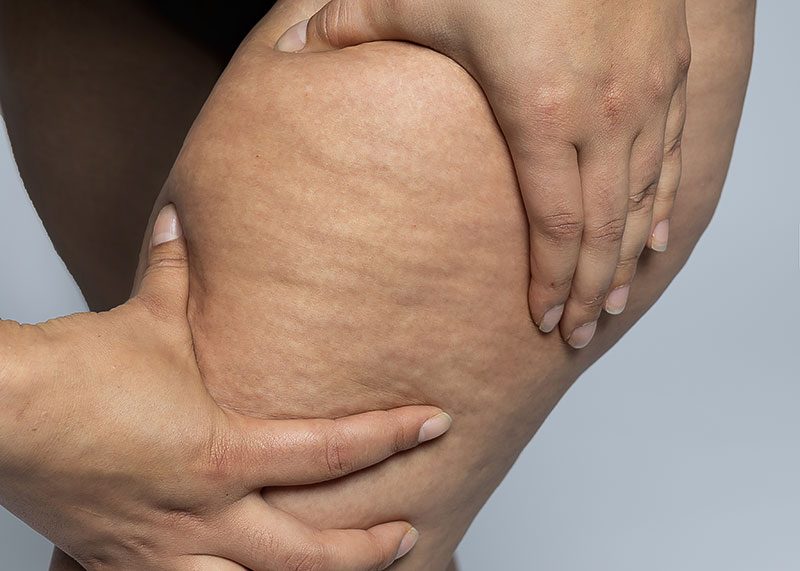
Who is affected by lipedema?
With lipedema, almost exclusively women are affected. The reasons are suspected to lie in estrogen receptors. Research into the causes is currently being pursued further and is the subject of ongoing research into causal therapy. Lipedema changes are assumed to occur in approximately 10% of women. A blood test for lipedema does not yet exist. The diagnosis is therefore made by the examiner and occasionally requires, despite the practitioner's utmost professionalism, objective cooperation from the patients.
What is the problem with this altered lipedema fat?
The fat largely decouples itself from the metabolism and no longer takes part in weight-loss processes. The imbalance between the trunk and the extremities thus becomes worse.
Another problem is the altered colloid osmotic pressure!?
What does that mean? Take a glass of water and divide it in the middle with a membrane that only lets the water through. Now pour salt onto one side, and where the levels were once equal you will see water move toward the salt side, and you can now perceive two different levels in the same glass.
In our example above, the lipedema fat is the salt and causes increased leakage of water out of the finest vessels, the so-called capillaries. Capillaries are normally built for the exchange of nutrients, not to donate abundant fluid to the tissue. The capillaries become brittle and age prematurely. In technical terms we then speak of a capillary leak. Lipedema patients perceive a capillary leak through water retention and an increased tendency to bruising.
Water retention in lipedema?
Yes. A capillary leak as described above causes fluid to accumulate between the cells. Physiologically speaking, the body wants to return this fluid to the bloodstream. For this, our body uses the lymphatic system. Unfortunately, the lymphatic system is therefore overloaded fairly quickly, because it is not designed for these masses of fluid. To support the lymphatic system in its work, one now makes use of external compression. Less fluid between the cells means less inflammatory irritation and less pain.
How does lipedema start?
Lipedema progresses in stages. Once lipedema fat develops, it exerts an osmotic pull on fluid—there is increased colloid‑osmotic pressure. Water leaves the capillaries, where nutrient exchange normally occurs. When more fluid exits these tiny vessels, this is termed a capillary leak. The fluid accumulates between fat cells, additionally compressing veins and lymphatic vessels. The capillary leak is therefore a self‑reinforcing mechanism.
Everything about lipedema at a glance
- Stages, symptoms and self-diagnosis
- Treatment: lymph-sparing liposuction (WAL) in our clinic
- Conservative therapy: compression, lymphatic drainage, exercise, nutrition
- Costs and health insurance – what applies since 2026
- Frequently asked questions about lipedema surgery
What treatment options are there for lipedema?
Initial consultations for patients with corresponding symptoms usually take place with physicians in vascular medicine, phlebology or gynecology. Many patients do not know the cause of their complaints—“Why do I have large legs despite a slim upper body?”
Therapy usually begins with a combination of manual lymphatic drainage and compression therapy to relieve symptoms. This approach is summarized as complex decongestive therapy (CDT). These therapies are important, but they do not causally treat the underlying disease.
Another therapeutic approach is decompression of veins and lymphatic vessels by removing the diseased fat cells. In plastic‑surgery terms, this is lymph‑sparing liposculpture (liposuction) of the affected areas. Several procedures may be necessary. Since 1 January 2026, liposuction in stages I to III can be covered by German statutory health insurance under certain medical requirements – see costs and insurance.
Which treatment is most effective for lipedema?
In addition to complex physical decongestive therapy, consisting of compression, manual lymphatic drainage and exercise, nutrition is an important building block. The probably most effective method, however, is the removal of the diseased fat cells in the course of a lymphatic-sparing liposuction, also called lymphological liposculpting. We perform this procedure very frequently in our lipedema clinic. For more information, please see Water-Assisted Liposuction.
Treatment facts
- Duration?
- Procedure duration approx. 3 hours
- Technique?
- Water-jet assisted liposuction (WAL)
- Anesthesia?
- General anesthesia
- Hospital stay?
- 1 night
- Follow-up?
- After 2 and 6 weeks
- Suture removal?
- Not necessary
- Aftercare?
- Compression garments for 6 weeks. Showering from the 2nd day after surgery. Socially presentable after 5-7 days. Sports after 4 weeks.
- Costs?
- Request now
Lassen Sie sich von uns beraten
Gerne berate ich Sie zu Ihrem persönlichen Anliegen im Rahmen meiner Beratungs- und Behandlungssprechstunde. Wir zeigen Ihnen im Falle eines Operationswunsches die gesamten Räumlichkeiten, damit Sie sich auf die angehende Behandlung optimal vorbereiten und einstellen können. Da wir eine Privatpraxis sind und uns mehr Zeit als üblich für unsere Patienten nehmen, bitten wir Sie um Verständnis, dass wir eine Beratungspauschale von 50€ berechnen.
Ihr Dr. Phil Million

Terminanfrage
Buchen Sie direkt Ihren Termin hier:
Kosten und Kostenübernahme

Medkred
Sichere Finanzierung zu fairen Konditionen
Mit unserem Finanzierungspartner medkred.de können Sie sich hochwertige Behandlungen leisten und behalten dabei Ihre finanzielle Freiräume. Wenn Sie Ihren anstehenden plastisch-ästhetischen Eingriff in günstigen, monatlich gleichbleibenden Raten finanzieren zu lassen möchten, hilft Ihnen unser Finanzierungspartner medkred.de gerne dabei.
Ihre Vorteile
- Individuelle Erfüllung der eigenen kosmetischen Wünsche
- Optimale Behandlung
- möglich Finanzierung zu attraktiven Konditionen
- Kurze Wartezeit bis zur Finanzierungszusage
Medkred - Infos zum Ablauf
Weiteren Informationen über den Finanzierungsablauf erhalten Sie auf der Website von Medkred unter www.medkred.de. Oder setzten Sie sich einfach mit dem medkred-Team unter der Rufnummer 0221/390 99 55 0 in Verbindung.

Finanzierungsmöglichkeiten Ihrer Schönheits-OP
Sie wünschen eine Veränderung Ihrer Figur oder Ihres Gesichtes? Dann kommen jetzt viele Fragen auf Sie zu. Eine Frage bei der Machbarkeit einer Schönheits-OP ist auch für viele Menschen die Kostenfrage. Der operative Eingriff bei einem vertrauensvollen Arzt mit hohem Qualitätsanpruch sollte dabei für Sie allerdings im Vordergrund stehen. Je nach gewünschter Behandlung, z.B. eine Brustvergrößerung, eine Fettabsaugung oder eine Bauchdeckenstraffung, variieren die Kosten für diese Operation.
Wir möchten Sie unterstützen
Bei der Frage: „Wie finanziere ich meine Schönheits-OP?“ möchten wir Sie unterstützen. Dass der notwendige Betrag für den Eingriff nicht unmittelbar zur Verfügung steht, soll kein Hindernis für die Erfüllung Ihrer Wünsche sein. Wir zeigen Ihnen unterschiedliche, bequeme Möglichkeiten zur Finanzierung Ihrer Schönheits-OP in Raten.
Finanzierung medizinscher Behandlungen und Schönheit-OPs
Wir haben zwei kompetente Finanzierungspartner gefunden, die sich auf die Finanzierung medizinischer Behandlungen spezialisiert haben und die Ihnen bei Bedarf Ihren Wunsch nach Veränderung und nach einer Schönheits-OP erfüllen können. Bitte prüfen Sie die Angebote eingehend und lassen Sie sich umfassend beraten, damit bei der Rückzahlung keine Probleme aufkommen und Sie sich die monatlichen Raten problemlos leisten können. Konditionen und Ablauf der Finanzierung müssen Sie direkt mit Medkred oder Medipay besprechen. Beide Anbieter stehen Ihnen sowohl online als auch telefonisch zur Verfügung.
