
Kosten für eine Schönheits-OP werden in der Regel nicht von der Kasse übernommen. Liegt ein entsprechender Krankheitswert vor kann in seltenen Fällen eine Kostenbeteiligung bei der Krankenkasse beantragt werden. Wir werden Sie ehrlich beraten ob eine Kostenübernahmeerklärung an die Krankenkasse Sinn macht und Sie entsprechend unterstützen.
Um Ihnen Ihren Wunscheingriff zu ermöglichen bieten wir individuelle Finanzierungsmodelle und Teilzahlungen an. Lassen Sie sich gerne bei uns beraten.
Facelift in Oldenburg – Facial Lift Without a Mask Effect
Facelift – facial tightening: what lies behind it?
The facelift is one of the best-known terms in plastic surgery and means the tightening of the face. Over the past decades the methods have become considerably more refined: through an ever better understanding of the individual anatomical layers of the face, lifts can be planned in a more minimally invasive way today. A facelift raises the sunken soft tissue of the face again and thereby smooths the cheek, neck and, where appropriate, the forehead area. Small lines around the mouth and eyes we treat in combination – for example with the transfer of nano fat or medical needling. At our practice clinic in Oldenburg we plan every facelift individually according to your findings.
What can I expect from a facelift?
Most patients have great respect for a facelift because they know examples of over-tightening from television or social media. Our aim is a rejuvenation of the face by 5 to 10 years – a fresher expression without looking operated on.
How is a facelift carried out?
The incision runs in front of and partly behind the ear. If the facelift is combined with a forehead lift, the incision extends to behind the front hairline. What is tightened is the stable subcutaneous tissue (SMAS) – that is what gives a long-lasting result. A facelift can win back about 5 to 10 years; if the soft tissue sinks again after that time, the procedure can be repeated. We do not want to create a mask-like appearance; there are too many negative examples of that. Facial expression and natural features are preserved.
At what age is a facelift carried out?
Most frequently in patients over 50. Depending on genetic predisposition, however, the soft tissue and the skin of the face can slacken before the age of 50. Anyone with a history of cortisone treatment or considerable weight loss behind them sometimes benefits from a facelift considerably earlier.
Treating the marionette line with hyaluronic acid?
The marionette line can only be treated with hyaluronic acid with difficulty – at least not without creating a “moon face”. The facelift produces the better effect: we return the soft tissue whose sinking causes the marionette line to its original position.
What does a facelift cost?
The cost depends on the effort involved: is a pure mid-face lift performed, or is a simultaneous neck lift required, possibly with local liposuction? The facelift can be combined with many methods, and that influences the price. Smaller variants of the facelift, already with a considerable effect, start at about €5,000. After the first consultation you receive a fixed cost estimate.
Which anaesthesia for a facelift?
We carry out smaller variants of the facelift under local anaesthesia with light sedation. We are happy to offer larger lifting operations under general anaesthesia where required. We will gladly draw up your individual treatment plan.
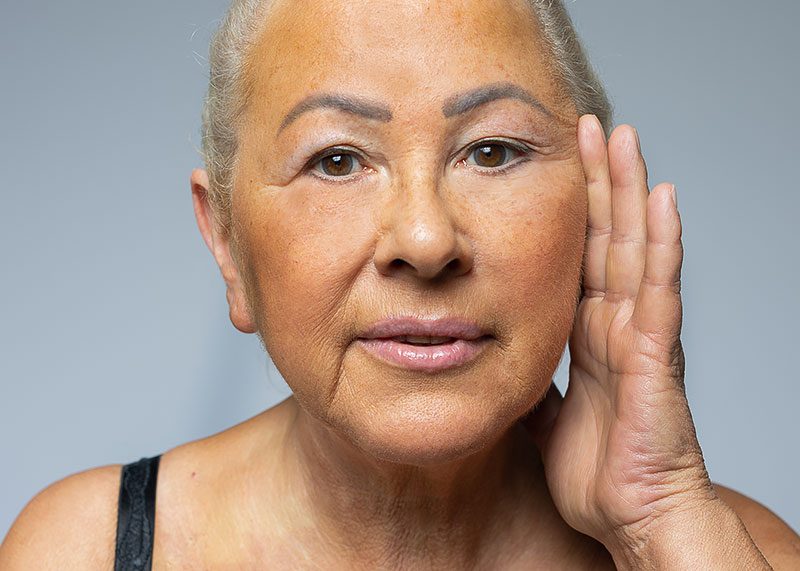
How does the facelift work at our practice clinic?
As early as the preparatory consultation with advice, detailed information about risks and an examination, we plan the operation. Our aim is to respond to your wishes and needs as well as possible before the procedure.
On the day of the operation, which we carry out in our own rooms in Oldenburg, you are scheduled in such a way that long waiting times are avoided. I will then go through what we discussed with you once more and repeat the markings. Our nursing and anaesthesia team will look after you. We carry out larger lifts as an inpatient procedure and the mini lift as an outpatient one. If you stay overnight, a nurse looks after you throughout the night; I myself am close by and take personal care of your physical wellbeing.
Advantages, disadvantages and risks of a facelift
The advantage of a facelift lies in the considerably younger appearance of the facial contours, which would be practically impossible without an operation. Alternatives are a lift with hyaluronic acid and laser treatments – with an advanced ageing process, however, they reach their limits and no longer deliver a satisfying result. After the procedure small bruises and areas of hardening often occur which loosen considerably within the first six months. As with every operation, infections and wound healing problems are possible, and rarely temporary numbness in the cheek area.
What should be considered after a facelift?
- A compression bandage measured specially for you supports the result: permanently for 2 weeks, then for a further 4 weeks at night.
- During the first week we recommend sleeping with the upper body slightly raised, for example on a thick pillow.
- We remove the hair-fine stitches after 7 days at the follow-up appointment; the thin plasters can often be covered by your hair until then.
- Showering is possible from the 2nd day after the operation, and you are able to face other people after about 14 days.
- From 14 days we recommend massaging yourself in order to loosen areas of hardening in the inner wound area.
- Sport after 6 weeks; check-up appointments after 2 and 6 weeks.
Facelift in Oldenburg – natural, personal, honest advice
Whether a mini lift, a MACS lift or a combination with an eyelid lift and a neck lift: what will do your face good is something we see in a personal conversation. You receive an honest assessment of which methods make sense – and which do not. Arrange a consultation appointment at our practice clinic.
Frequently asked questions
What does a facelift realistically achieve?
A rejuvenation of the face by about 5 to 10 years – a fresher expression without looking operated on. Facial expression and natural features are preserved; a mask-like result is expressly not what we want.
How is a facelift carried out?
The incision runs in front of and partly behind the ear. What is tightened is the stable subcutaneous tissue (SMAS), not just the skin – that is what gives a long-lasting result. Combined with a forehead lift, the incision extends to behind the front hairline.
At what age does a facelift make sense?
Most frequently in patients over 50. Depending on predisposition, after cortisone treatment or after considerable weight loss, slackening can also set in earlier – you would then benefit correspondingly sooner.
Which anaesthesia is used for a facelift?
We carry out smaller variants under local anaesthesia with light sedation, and larger lifting operations under general anaesthesia. We determine the right route in your individual treatment plan.
Can the marionette line be treated with hyaluronic acid?
Only with difficulty – too much hyaluronic acid creates a round “moon face”. For marionette lines the facelift works better, because we return the sunken soft tissue that causes the line to its original position.
What does a facelift cost in Oldenburg?
The cost depends on the effort involved: a pure mid-face lift or a simultaneous neck lift, possibly with local liposuction. Smaller variants of the facelift, already with a considerable effect, start at about €5,000. After the first consultation you receive a fixed cost estimate.
How long will I be restricted after the facelift?
You are able to face other people after about 14 days; the hair-fine stitches are removed after 7 days. A compression bandage is worn permanently for 2 weeks and for a further 4 weeks at night, showering is possible from the 2nd day and sport after 6 weeks.
Can a facelift be repeated?
Yes. If the soft tissue sinks again after years, the procedure can be repeated. In between, the result can be maintained with hyaluronic acid, botox or laser.
Treatment facts
- Duration?
- 3 h
- Technique?
- MACS lift
- Anesthesia?
- General anesthesia
- Hospital stay?
- Inpatient
- Follow-up?
- After 2 and 6 weeks
- Suture removal?
- After 7 days
- Aftercare?
-
Compression bandage for 2 weeks
permanently and for another 4 weeks at night.
Showering possible from the 2nd day after surgery.
Socially presentable after 14 days.
Sports after 6 weeks.
- Costs?
- Request now
Lassen Sie sich von uns beraten
Gerne berate ich Sie zu Ihrem persönlichen Anliegen im Rahmen meiner Beratungs- und Behandlungssprechstunde. Wir zeigen Ihnen im Falle eines Operationswunsches die gesamten Räumlichkeiten, damit Sie sich auf die angehende Behandlung optimal vorbereiten und einstellen können. Da wir eine Privatpraxis sind und uns mehr Zeit als üblich für unsere Patienten nehmen, bitten wir Sie um Verständnis, dass wir eine Beratungspauschale von 50€ berechnen.
Ihr Dr. Phil Million

Terminanfrage
Buchen Sie direkt Ihren Termin hier:
Kosten und Kostenübernahme

Medkred
Sichere Finanzierung zu fairen Konditionen
Mit unserem Finanzierungspartner medkred.de können Sie sich hochwertige Behandlungen leisten und behalten dabei Ihre finanzielle Freiräume. Wenn Sie Ihren anstehenden plastisch-ästhetischen Eingriff in günstigen, monatlich gleichbleibenden Raten finanzieren zu lassen möchten, hilft Ihnen unser Finanzierungspartner medkred.de gerne dabei.
Ihre Vorteile
- Individuelle Erfüllung der eigenen kosmetischen Wünsche
- Optimale Behandlung
- möglich Finanzierung zu attraktiven Konditionen
- Kurze Wartezeit bis zur Finanzierungszusage
Medkred - Infos zum Ablauf
Weiteren Informationen über den Finanzierungsablauf erhalten Sie auf der Website von Medkred unter www.medkred.de. Oder setzten Sie sich einfach mit dem medkred-Team unter der Rufnummer 0221/390 99 55 0 in Verbindung.

Finanzierungsmöglichkeiten Ihrer Schönheits-OP
Sie wünschen eine Veränderung Ihrer Figur oder Ihres Gesichtes? Dann kommen jetzt viele Fragen auf Sie zu. Eine Frage bei der Machbarkeit einer Schönheits-OP ist auch für viele Menschen die Kostenfrage. Der operative Eingriff bei einem vertrauensvollen Arzt mit hohem Qualitätsanpruch sollte dabei für Sie allerdings im Vordergrund stehen. Je nach gewünschter Behandlung, z.B. eine Brustvergrößerung, eine Fettabsaugung oder eine Bauchdeckenstraffung, variieren die Kosten für diese Operation.
Wir möchten Sie unterstützen
Bei der Frage: „Wie finanziere ich meine Schönheits-OP?“ möchten wir Sie unterstützen. Dass der notwendige Betrag für den Eingriff nicht unmittelbar zur Verfügung steht, soll kein Hindernis für die Erfüllung Ihrer Wünsche sein. Wir zeigen Ihnen unterschiedliche, bequeme Möglichkeiten zur Finanzierung Ihrer Schönheits-OP in Raten.
Finanzierung medizinscher Behandlungen und Schönheit-OPs
Wir haben zwei kompetente Finanzierungspartner gefunden, die sich auf die Finanzierung medizinischer Behandlungen spezialisiert haben und die Ihnen bei Bedarf Ihren Wunsch nach Veränderung und nach einer Schönheits-OP erfüllen können. Bitte prüfen Sie die Angebote eingehend und lassen Sie sich umfassend beraten, damit bei der Rückzahlung keine Probleme aufkommen und Sie sich die monatlichen Raten problemlos leisten können. Konditionen und Ablauf der Finanzierung müssen Sie direkt mit Medkred oder Medipay besprechen. Beide Anbieter stehen Ihnen sowohl online als auch telefonisch zur Verfügung.
