
Lipedema - Fat Distribution Disorder
Lipedema - Fat Distribution Disorder
Oldenburg - Specialist Clinic for the Treatment of a Fat Distribution Disorder
What is lipedema?
Lipedema is a fat distribution disorder of the legs/buttocks and/or arms. The fat increases pathologically and the fat cells vary in size. This produces a coarsely textured skin surface. In the further course, disproportions relative to the body's center become apparent. The trunk is therefore noticeably slimmer than the extremities, that is, the arms and legs. While entire extremities are frequently affected, different regions of the extremities can also be affected. One therefore occasionally speaks of an upper-arm or lower-arm type, an upper-leg (thigh) or lower-leg (calf) type. Lipedema always occurs symmetrically.
Who is affected by lipedema?
With lipedema, almost exclusively women are affected. The reasons are suspected to lie in estrogen receptors. Research into the causes is currently being pursued further and is the subject of ongoing research into causal therapy. Lipedema changes are assumed to occur in approximately 10% of women. A blood test for lipedema does not yet exist. The diagnosis is therefore made by the examiner and occasionally requires, despite the practitioner's utmost professionalism, objective cooperation from the patients.
What is the problem with this altered lipedema fat?
The fat largely decouples itself from the metabolism and no longer takes part in weight-loss processes. The imbalance between the trunk and the extremities thus becomes worse.
Another problem is the altered colloid osmotic pressure!?
What does that mean? Take a glass of water and divide it in the middle with a membrane that only lets the water through. Now pour salt onto one side, and where the levels were once equal you will see water move toward the salt side, and you can now perceive two different levels in the same glass.
In our example above, the lipedema fat is the salt and causes increased leakage of water out of the finest vessels, the so-called capillaries. Capillaries are normally built for the exchange of nutrients, not to donate abundant fluid to the tissue. The capillaries become brittle and age prematurely. In technical terms we then speak of a capillary leak. Lipedema patients perceive a capillary leak through water retention and an increased tendency to bruising.
Water retention in lipedema?
Yes. A capillary leak as described above causes fluid to accumulate between the cells. Physiologically speaking, the body wants to return this fluid to the bloodstream. For this, our body uses the lymphatic system. Unfortunately, the lymphatic system is therefore overloaded fairly quickly, because it is not designed for these masses of fluid. To support the lymphatic system in its work, one now makes use of external compression. Less fluid between the cells means less inflammatory irritation and less pain.
Compression garments in lipedema?
For every lipedema patient, compression clothing is certainly her alter ego. The only reason for wearing compression garments regularly is the clinical picture that increases over time. There are different types of compression here. First and foremost, it is important that the garment is custom-made in order to ensure even compression. A distinction is made between circular-knit and flat-knit. Flat-knit provides more effective compression and is better indicated when deep skin folds are already present. Many patients, especially in earlier stages of lipedema, find circular-knit more comfortable to wear. Personally, I am pragmatic about this and advocate compression — and some compression is better than none! Unfortunately, the best compression garment is of no use at all if it only fills the wardrobe.
Stages of lipedema?
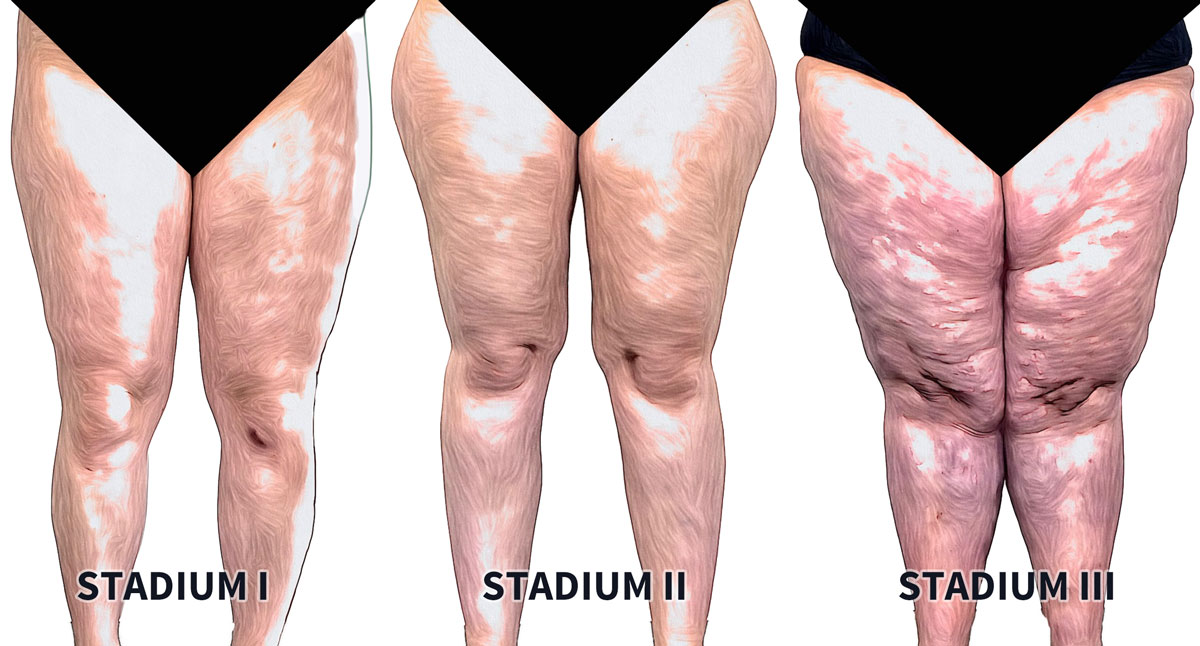
Lipedema - Stage I:
- visible tendency of the thighs toward a "saddlebag" shape
- the skin is smooth and even on the surface
- the subcutaneous tissue feels thickened and still soft
- particularly on the inner thighs and knees, structures can sometimes be felt that feel like polystyrene beads in a plastic bag.
Lipedema - Stage II:
- pronounced "saddlebag" shape of the thighs
- uneven skin surface with large dimples
- the subcutaneous tissue is thickened and irregular in consistency.
Lipedema - Stage III:
- pronounced increase in circumference, subcutaneous tissue heavily thickened and hardened,
- very uneven skin surface
- subcutaneous tissue thickened and hardened
- deforming fat lobes (dewlap formation) on the inner thighs and the knee joints
- fat rolls partly hanging down over the ankles
- knock-knee position, resulting in permanently high incorrect loading of the joints
Lipedema - Stage IV:
- Lipo-lymphedema: In addition to the lipedema, a lymphedema develops due to a capillary leak, and the affected regions swell in a protracted, painful manner. The capillary leak already occurs in early phases of lipedema. The lymphatic congestion then leads to the development of so-called elephantiasis. Very few of those affected develop a stage IV, which is why stages I–III are decisive.
Does every stage I become a stage III?
What we gain in terms of knowledge from the patient histories is that a definite progression of lipedema in its intensity cannot be predicted. Changes in the hormonal balance appear to play a fundamental role in the development and further progression of the disease. Correlations are frequently found with puberty, taking the contraceptive pill, thyroid disorders, pregnancies and menopause.
What is important for oneself: if I have lipedema, I must not fall into a panic. Generations before me were already able to live with it. My advantage is that medicine now understands this clinical picture better and keeps approaches to solutions ready to alleviate my suffering.
When is the right time for lipedema surgery?
According to current knowledge, patients with lipedema benefit from early surgery, that is, from suctioning out the diseased fat cells. This is simply due to the protection of the tissue, which is then not permanently exposed to a capillary leak. However, one can definitely not speak of imminent danger!
In my opinion, doctor and patient decide on the right date together. I consider indications of disease dynamics, that is, of a rapid change, to be meaningful. Let's not kid ourselves, the costs for surgical therapy of lipedema are considerable. Unfortunately, very few of those in need of treatment have saved the money for it, and often the frustration over a lack of cost coverage by the health insurers is high. I suspect that this is where the crux of the matter lies. It simply cannot be said which lipedema exhibits high disease dynamics and which does not. Thus it also cannot be said that every patient generally benefits from early surgery. The health insurers see it this way too.
How do I determine whether I have lipedema?
The initial diagnosis is frequently an incidental finding by specialists in the fields of phlebology, vascular surgery and gynecology. For self-diagnosis there are now well-standardized questionnaires regarding the patient's complaints and the actual impression of the examiner. Feel free to use our lipedema self-test on this website. Important here is an objective approach; there is no "yes-and-no" — so if something does not apply 100%, then it is a "no".
What is the best exercise for lipedema?
I personally favor tissue-friendly exercise for lipedema in order to keep complaints after physical exertion to a minimum. Anyone who moves is already doing quite a few things right. Swimming and aqua aerobics deserve particular mention. The water exerts an even pressure on the tissue, similar to a compression garment. The movement stimulates lymphatic drainage, just as with manual lymphatic drainage. In addition, one burns energy during this time, which has a positive effect on the calorie balance. The time is therefore used more effectively than with manual lymphatic drainage.
How do I eat properly with lipedema?
One thing first: a scientifically recognized diet for lipedema does not currently exist. I advise against radical diets such as the keto diet, etc. Radical diets apparently have a negative influence on lipedema, especially the associated yo-yo effect. We recommend a consistent, long-term calorie deficit.
Manual lymphatic drainage in lipedema?
Manual lymphatic drainage has a positive effect on lipedema. Through tactile, gentle touch, lymphatic flow is stimulated. Radical massages or wraps, on the other hand, can stimulate lymphatic congestion. This is roughly comparable to a pimple that you keep squeezing — the local inflammatory reaction then also increases. Water sports can likewise stimulate lymphatic flow and increase calorie expenditure.
Which treatment is most effective for lipedema?
In addition to complex physical decongestive therapy, consisting of compression, manual lymphatic drainage and exercise, nutrition is an important building block. The probably most effective method, however, is the removal of the diseased fat cells in the course of a lymphatic-sparing liposuction, also called lymphological liposculpting. We perform this procedure very frequently in our lipedema clinic. For more information, please see Water-Assisted Liposuction.
How can lipedema be operated on?
In our practice clinic we use one of the most established methods of liposuction with state-of-the-art technology. Our liposuctions are performed with a water jet. The procedure is also called Water-Assisted Liposuction. With this, the fat cells can be gently released from their network by means of a special solution mixture. At the same time, the fat cells can be carefully removed by a slight negative pressure. To illustrate the procedure, please feel free to use the following animation.
Why have lipedema surgery performed by a plastic surgeon?
As part of the specialist training to become a plastic surgeon, liposuctions are an elementary component, so that you can expect qualified suctioning with regard to function and aesthetics. No other specialist category, apart from the plastic and aesthetic surgeon, comes into relevant contact with liposuctions during specialist training.
Lymphatic-sparing surgery — what does that mean?
The goal is the reduction of the lipedema fat cells. We want to suction these out as gently as possible in order to relieve the lymphatic system. It is important here to suction as much as possible in the longitudinal direction of the extremities so as not to damage the lymphatic vessels, which also run longitudinally. After surgery, the lymphatic vessels should ultimately function better than before.
Dimples and grooves after liposuction?
It is of course the case that a leg which does not require any suctioning is always smoother than a leg which has to be suctioned over a large area. Most lipedema areas already exhibit considerable dimples before the operation. In the course of a liposuction, as a plastic surgeon I am interested — alongside good function and relief of symptoms — in as smooth a result as possible, so that you may also like to show your legs afterward. Occasionally, despite all care, it can happen that small dimples are visible. For a good result, I allow myself sufficient time in the operating room.
Surgery for lipedema under general anesthesia or twilight sedation?
We perform both procedures, but since most lipedema operations are so-called large-volume liposuctions (around 5 l of pure fat), we see more safety in performing them under general anesthesia. A tumescent anesthesia, that is, a local anesthesia, is additionally carried out in our practice for less postoperative pain. The anesthesia costs are included in our prices, so that you have more planning security.
How many operations are necessary for lipedema?
The number of operations depends on the volume to be suctioned. We frequently remove around 5 l of pure fat per operation. With added tumescent solution, this can sometimes be considerably more. We are of course endeavoring to keep the number of operations low. During the initial consultation, we can already tell you fairly precisely the number of operations to be expected.
Does lipedema come back in a different place after surgery?
If a lipedema on the legs has been successfully treated surgically and there was already a tendency toward lipedema on the arms beforehand, it may be that these exhibit more disease activity in the future than the already treated legs.
Does lipedema come back at the operated site?
According to current knowledge, it is known that after approximately 10 years individual fat cell deposits can newly develop in the sense of a lipedema. This may happen, but does not have to. Why is that? In a liposuction for lipedema, the diseased fat cells and also the healthy surrounding fat cells are significantly reduced. However, the fat cells cannot be completely removed. Individual cells can mutate into lipedema cells over the course of life and increase in number as well as grow larger.
Sagging skin after lipedema surgery — what to do?
Depending on the severity of a lipedema, the circumferences of the respectively affected areas can take on large dimensions. If, depending on the skin condition, the restoring force is not sufficient after reduction of the internal volume, we offer tightening operations using modern methods. In selected cases, an internal tightening is possible; in this, argon gas is selectively ignited through tiny access points, as in liposuction, and collagen synthesis is stimulated in order to make the skin shrink. I have a special technique to ensure a retraction stimulus of the skin, that is, a shrinking of the skin, already during the actual liposuction. We are happy to provide more information during our consultation.
Minimally invasive tightening with almost no scar
With our Argon Plasma technology, we can combine tightening with liposuction without creating additional scars. Already during the informational consultation, I can tell you whether this additional service makes sense for you and how we will incorporate it into your individual surgical plan. Through minimally invasive tightening, we can achieve even smoother results after large-volume liposuctions. We would be happy to advise you about the possibilities and the low risks during our consultation.
Please use the following video to illustrate the tightening process:
The following info flyer is intended to clarify the procedure even further:

Further information on Argo Plasma can be found here
Follow-up cost insurance for lipedema surgery?
No matter which operations are performed that are medically indicated but not always covered by the health insurer, they should be secured by follow-up cost insurance. After all, one does not buy a new car without insuring it accordingly either. In relation to the cost of the procedure, the amount is small; basic protection is usually sufficient. Medassure is one of our partners and would be happy to advise you.
Risks in lipedema surgery?
General risks are bleeding, infections and thromboses (blood clots in the deep venous system). In general, risks can be reduced through good surgical planning. One should therefore keep the procedure time short, position the patient well, not extend wound surfaces larger than urgently necessary, and mobilize the patient again early after surgery. Through the good compression of the prescribed garments as well as the medicinal thrombosis prophylaxis, risks are further significantly reduced.
How long can I not work after a lipedema operation?
For 3 days you already feel quite restricted; you can walk, but you are glad if you do not have too much on your plate. After a week you feel better than is good for you, but take it easy in the first weeks. Only take short walks. After 2 weeks most patients can work again, some even after just one week. Of course this depends on your personal professional situation. In any case, one is presentable in public after 5-7 days.
How long should compression garments be worn after liposuction for lipedema?
Compression should be worn permanently for 6 weeks after the operation. In general, for lipedema — even after surgery — the recommendation is to wear compression garments for 12 hours per day. What you as a patient make of this is up to you. After a successful liposuction, many patients do without external compression in the long term.
Is one cured of lipedema after liposuction?
If one speaks of a cure, then the cause of the problem has been eliminated. But since we currently do not yet have a targeted therapy at the cellular level — that is, there is no medication against lipedema — lipedema currently cannot be cured. Through a liposuction for lipedema, symptoms and appearance can be improved; a cure, however, is unfortunately not yet possible.
One should see liposuction for lipedema as an opportunity to treat one's disease as well as possible.
Treatment facts
- Duration?
- Procedure duration approx. 3 hours
- Technique?
- Water-Assisted Liposuction (WAL)
- Anesthesia?
- General anesthesia
- Hospital stay?
- inpatient
- Follow-up?
- After 2 and 6 weeks
- Suture removal?
- not necessary
- Aftercare?
- Compression garments for 6 weeks. Showering from the 2nd day after surgery. Presentable in public after 5-7 days. Sports after 4 weeks.
- Costs?
- Request now