Um möglichst vielen Patientinnen Zugang zu einer operativen Behandlung des Lipödems zu ermöglichen, möchten wir Ihnen eine faire Kostenstruktur anbieten.
Da es sich bei der Lipödem Operation häufig nicht um eine Kassenleistung handelt, wird die Operation in der Regel als Selbstzahlerleistung wahrgenommen. Natürlich stellt dies aufgrund der Kosten für viele der Patientinnen eine enorme finanzielle Hürde dar.
Wir haben ein individuelles Konzept entwickelt um Ratenzahlungen für die Liposuktion beim Lipödem anzubieten. Natürlich können auch bei Bedarf die üblichen Finanzdienstleister wie beispielsweise MedKred herangezogen werden.
Lipedema – pathological fat distribution disorder
Lipedema – pathological fat distribution disorder
What is lipedema?
Lipedema is a disproportionate fat‑distribution disorder affecting the limbs and remains under‑diagnosed in Germany. It is estimated that around 10% of women in Germany tend to develop lipedema‑like fat deposits on the arms and legs. The condition is characterized by a symmetrical increase in subcutaneous fat on the extremities (arms and/or legs, with or without the buttocks). Different types of lipedema are described depending on location. The diseased fat cells cannot be reduced by dieting. Those affected are usually patients after phases of hormonal changes such as puberty, pregnancy or menopause. Typical symptoms include marked tension in the affected body regions, a feeling of heaviness, pain and a tendency to bruising. So‑called “caliber jumps” toward unaffected areas are also typical. Four stages of lipedema have been described that can be traversed over the course of the disease. Lipedema often occurs together with overweight. The most important step to limit progression is maintaining a calorie deficit, which may help prevent lipedema‑like changes in predisposed individuals.
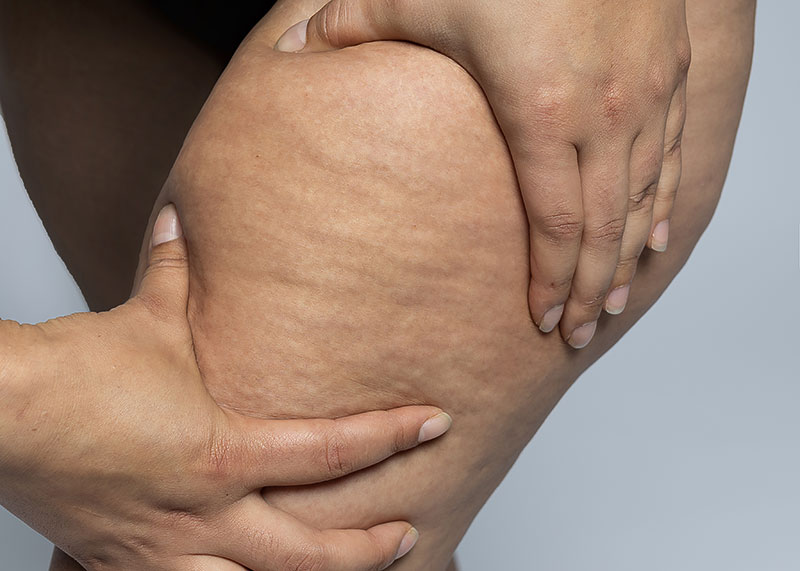
Stages of lipedema
The fat‑distribution disorder develops—regardless of the previously diagnosed lipedema type—across four stages:
Lipedema – Stage I:
- visible tendency of the thighs toward a “riding‑breeches” shape
- the skin is smooth and even
- the subcutaneous tissue feels thickened and soft
- especially on the inner thighs and knees, structures can sometimes be palpated that feel like polystyrene beads in a plastic bag.
Lipedema – Stage II:
- pronounced “riding‑breeches” shape of the thighs
- uneven skin surface with large dimples
- the subcutaneous tissue is thickened but still soft.
Lipedema – Stage III:
- marked increase in circumference; subcutaneous tissue markedly thickened and firm
- very uneven skin surface
- subcutaneous tissue thickened and indurated
- deforming fat lobules (apron‑like folds) at the inner thighs and knee joints
- fat pads sometimes hanging over the ankles
- knock‑knee (genu valgum) posture with persistently increased joint loading
Lipedema – Stage IV:
- Lipo‑lymphedema: in addition to lipedema, a lymphatic edema develops due to capillary leak, leading to persistent, painful swelling in the affected regions. The capillary leak can already occur in early stages. The lymphatic congestion can progress to so‑called elephantiasis.
What treatment options are there for lipedema?
Initial consultations for patients with corresponding symptoms usually take place with physicians in vascular medicine, phlebology or gynecology. Many patients do not know the cause of their complaints—“Why do I have large legs despite a slim upper body?”
Therapy usually begins with a combination of manual lymphatic drainage and compression therapy to relieve symptoms. This approach is summarized as complex decongestive therapy (CDT). These therapies are important, but they do not causally treat the underlying disease.
Another therapeutic approach is decompression of veins and lymphatic vessels by removing the diseased fat cells. In plastic‑surgery terms, this is lymph‑sparing liposculpture (liposuction) of the affected areas. Several procedures may be necessary. In stages I and II, statutory health insurers currently do not cover liposuction; many patients try—often unsuccessfully—to obtain coverage despite significant symptoms.
Which technique do we use in our clinic in Oldenburg?
In our clinic we use the Bodyjet system by Humanmed. This is one of the most modern devices on the market and enables a tissue‑sparing method via water‑jet‑assisted liposuction (WAL). The goal is to spare lymphatic vessels and prevent soft‑tissue edema—hence lymph‑sparing liposculpture. We work with blunt cannulas to be atraumatic and achieve even results after fat removal. Based on current scientific evidence, this is the most established method for reducing fat cells in lipedema.
How can I tell if I have lipedema
There are various self‑tests online—feel free to try ours at www.lipoedem-oldenburg.de. Those affected are often diagnosed with obesity (adiposity), which can be confusing. Lipedema, however, frequently occurs in parallel with obesity. Typical “caliber jumps” between trunk and legs or arms are then harder to detect. To differentiate in such cases, we use the waist‑to‑height ratio and waist‑to‑hip ratio. A helpful test is the pinch test: with lipedema, the outer thighs are more sensitive than the inner thighs, whereas in healthy people the inner thighs are more sensitive.
How much fat is removed in lipedema?
We specialize in large‑volume liposuctions as part of lipedema surgery. We have developed techniques that allow us, in selected cases, to remove more than 10 liters of pure fat per procedure (excluding fluids) without increasing patient risk. Lipedema surgery should be effective so that as few operations as possible are needed, minimizing internal scarring and downtime. We have not had a major complication (thrombosis, extensive infection or sepsis) in our clinic to date. In each of our >50 procedures per year in this field we work with utmost care to ensure good results and low risk.
How does lipedema start?
Lipedema progresses in stages. Once lipedema fat develops, it exerts an osmotic pull on fluid—there is increased colloid‑osmotic pressure. Water leaves the capillaries, where nutrient exchange normally occurs. When more fluid exits these tiny vessels, this is termed a capillary leak. The fluid accumulates between fat cells, additionally compressing veins and lymphatic vessels. The capillary leak is therefore a self‑reinforcing mechanism.
Is liposuction useful in early lipedema stages?
Current evidence indicates that early removal of diseased fat cells has a positive effect on disease progression, as the development of the capillary leak described above is reduced.
What should you avoid eating with lipedema?
Exercise and calorie restriction are important pillars in the treatment of lipedema. A balanced diet while avoiding excess caloric intake is always beneficial. According to current knowledge, there is no specific lipedema diet.
Lipedema or cellulite?
Cellulite refers to an irregular skin surface, primarily due to the parallel arrangement of collagen fibers in women. Like lipedema, cellulite can also affect young, athletic women. In lipedema, however, there is hypersensitivity and a disproportionate increase in circumference.
Current G‑BA decision on stage‑independent cost coverage for lipedema
This decision has not yet been recognized by the Federal Ministry of Health. It is currently unclear when the new regulations will take effect, what the specific criteria will look like, and who will actually be entitled to cost coverage. The final design and implementation of the criteria are therefore still pending.
Lipedema is a chronic fat‑distribution disorder that predominantly affects arms and legs. It is characterized by symmetrical fat accumulation, pain, and pressure sensitivity. Because lipedema is a diagnosis of exclusion and the above symptoms may also occur in venous insufficiency or lipohypertrophy, the following criteria must be considered:
- BMI below 35
- with a BMI between 32 and 35, the waist‑to‑height ratio is considered
- clear disproportion between abdomen and hips/legs/arms
- exclusion of other conditions such as obesity, lipohypertrophy, or lymphedema
- pressure pain (tenderness)
Lipedema as a health‑insurance benefit with us?
We are highly specialized in the treatment of lipedema. Our service goes far beyond a simple liposuction covered by insurance. We address border zones, remove significantly larger fat volumes per session to reduce downtime, and perform simultaneous skin tightening with state‑of‑the‑art technology.
Our advanced treatment concept—refined over many years—is, unfortunately, not included in statutory insurance coverage even after the Federal Joint Committee’s decision. Whether your insurer contributes to treatment in our private clinic must be clarified individually with your insurance provider.
What does lipedema treatment in our clinic involve?
During the preparatory consultation—including detailed counseling, informed consent, and examination—the diagnosis is established and surgery is planned. Our goal is to address your wishes and needs as best as possible **before** the operation and to mark and document the areas to be treated. On the day of surgery, which we perform on our own premises, we schedule you so that long waiting times are avoided. I will then review everything with you once again and repeat the markings. Our nursing and anesthesia teams will take care of you. We perform **large‑volume liposuction**, which can occasionally cause circulatory complaints; therefore, we will accommodate you **overnight** in one of our patient rooms. A nurse will look after you throughout the night. I will be nearby and personally attend to your wellbeing. After the final visit the next day, you can usually leave our clinic. **Manual lymphatic drainage** should be resumed soon after surgery. If your physiotherapist is hesitant because of the small wounds, we can temporarily connect you with our in‑house physiotherapist.Advantages/disadvantages/risks of liposuction for lymphedema—what alternatives exist?
The treated regions become **considerably slimmer** after the procedure. Per session, a maximum of **5 liters of pure fat** can be removed without exposing you to an excessive risk of circulatory collapse. This means that **several sessions** may be necessary. Treatment planning is individualized. In addition to surgery, **exercise, nutrition, compression therapy and manual lymphatic drainage** are essential. Because lipedema is a progressive disease, I currently see **no alternative** to liposuction.What should be considered after liposuction?
The **flat‑knit compression garment** should continue to be worn. **Sutures do not need to be removed.** Social and work activities are usually possible after **7–14 days**. Sports can be cautiously resumed after **4 weeks**, and showering is possible from **day 5** after the operation.Treatment facts
- Duration?
- Procedure duration approx. 3 hours
- Technique?
- Water-jet assisted liposuction (WAL)
- Anesthesia?
- General anesthesia
- Hospital stay?
- Inpatient
- Follow-up?
- After 2 and 6 weeks
- Suture removal?
- Not necessary
- Aftercare?
- Compression garments for 6 weeks. Showering from the 2nd day after surgery. Socially presentable after 5-7 days. Sports after 4 weeks.
- Costs?
- Request now
Kosten bei einer Lipödembehandlung
Lassen Sie sich von uns beraten
Gerne berate ich Sie zu Ihrem persönlichen Anliegen im Rahmen meiner Beratungs- und Behandlungssprechstunde. Wir zeigen Ihnen im Falle eines Operationswunsches die gesamten Räumlichkeiten, damit Sie sich auf die angehende Behandlung optimal vorbereiten und einstellen können. Da wir eine Privatpraxis sind und uns mehr Zeit als üblich für unsere Patienten nehmen, bitten wir Sie um Verständnis, dass wir eine Beratungspauschale von 50€ berechnen.
Ihr Dr. Phil Million

Terminanfrage
Buchen Sie direkt Ihren Termin hier:
Kosten und Kostenübernahme
Kosten für eine Schönheits-OP werden in der Regel nicht von der Kasse übernommen. Liegt ein entsprechender Krankheitswert vor kann in seltenen Fällen eine Kostenbeteiligung bei der Krankenkasse beantragt werden. Wir werden Sie ehrlich beraten ob eine Kostenübernahmeerklärung an die Krankenkasse Sinn macht und Sie entsprechend unterstützen.
Um Ihnen Ihren Wunscheingriff zu ermöglichen bieten wir individuelle Finanzierungsmodelle und Teilzahlungen an. Lassen Sie sich gerne bei uns beraten.
Um Ihnen Ihren Wunscheingriff zu ermöglichen bieten wir individuelle Finanzierungsmodelle und Teilzahlungen an. Lassen Sie sich gerne bei uns beraten.
Medkred
Sichere Finanzierung zu fairen Konditionen
Mit unserem Finanzierungspartner medkred.de können Sie sich hochwertige Behandlungen leisten und behalten dabei Ihre finanzielle Freiräume. Wenn Sie Ihren anstehenden plastisch-ästhetischen Eingriff in günstigen, monatlich gleichbleibenden Raten finanzieren zu lassen möchten, hilft Ihnen unser Finanzierungspartner medkred.de gerne dabei.
Ihre Vorteile
- Individuelle Erfüllung der eigenen kosmetischen Wünsche
- Optimale Behandlung
- möglich Finanzierung zu attraktiven Konditionen
- Kurze Wartezeit bis zur Finanzierungszusage
Medkred - Infos zum Ablauf
Weiteren Informationen über den Finanzierungsablauf erhalten Sie auf der Website von Medkred unter www.medkred.de. Oder setzten Sie sich einfach mit dem medkred-Team unter der Rufnummer 0221/390 99 55 0 in Verbindung.

Finanzierungsmöglichkeiten Ihrer Schönheits-OP
Sie wünschen eine Veränderung Ihrer Figur oder Ihres Gesichtes? Dann kommen jetzt viele Fragen auf Sie zu. Eine Frage bei der Machbarkeit einer Schönheits-OP ist auch für viele Menschen die Kostenfrage. Der operative Eingriff bei einem vertrauensvollen Arzt mit hohem Qualitätsanpruch sollte dabei für Sie allerdings im Vordergrund stehen. Je nach gewünschter Behandlung, z.B. eine Brustvergrößerung, eine Fettabsaugung oder eine Bauchdeckenstraffung, variieren die Kosten für diese Operation.
Wir möchten Sie unterstützen
Bei der Frage: „Wie finanziere ich meine Schönheits-OP?“ möchten wir Sie unterstützen. Dass der notwendige Betrag für den Eingriff nicht unmittelbar zur Verfügung steht, soll kein Hindernis für die Erfüllung Ihrer Wünsche sein. Wir zeigen Ihnen unterschiedliche, bequeme Möglichkeiten zur Finanzierung Ihrer Schönheits-OP in Raten.
Finanzierung medizinscher Behandlungen und Schönheit-OPs
Wir haben zwei kompetente Finanzierungspartner gefunden, die sich auf die Finanzierung medizinischer Behandlungen spezialisiert haben und die Ihnen bei Bedarf Ihren Wunsch nach Veränderung und nach einer Schönheits-OP erfüllen können. Bitte prüfen Sie die Angebote eingehend und lassen Sie sich umfassend beraten, damit bei der Rückzahlung keine Probleme aufkommen und Sie sich die monatlichen Raten problemlos leisten können. Konditionen und Ablauf der Finanzierung müssen Sie direkt mit Medkred oder Medipay besprechen. Beide Anbieter stehen Ihnen sowohl online als auch telefonisch zur Verfügung.